
Outperformance Comes in Bursts, Pain Comes in Stretches
What follows is based on my own experience as a quantitative trader. Other quants, using different models, different universes, or different constraints, may have reached different conclusions.
One of the first lessons I have learned is the importance of understanding the universe one is trading. I run one specific strategy focused on S&P 500 constituents, but most of my other strategies also include mid- and small-caps. I generally avoid microcaps because their low liquidity often makes backtests unrealistic and live trading difficult. It is very easy to produce extraordinary historical returns in illiquid stocks that cannot be replicated in the real world.
Even when I focus on relatively liquid small- and mid-caps with strong ranking profiles, the experience can be psychologically demanding. By ranking profile, I mean the relative attractiveness of a stock based on factors such as financial strength, business quality, growth, value, momentum, or a combination of several of these. In theory, a portfolio of highly ranked stocks should do well. In practice, the journey is rarely smooth.
What I have observed is that small and mid-caps often underperform the S&P 500 for extended periods. This can happen even when the strategy is fundamentally sound and has a strong long-term record. Over a two-year period, and often even over one year, my quantitative strategies have usually outperformed the S&P 500. But that outperformance does not usually come in a steady, comfortable way.
Instead, it often comes in bursts.
This is one of the most important lessons. A strategy may lag badly for months. You may see the S&P 500 rise 10% in five months while your own strategy is flat. That is not easy to endure. It feels as if something is wrong. It creates doubt. It tests your confidence in the model.
Then, suddenly, in a period of only six or eight weeks, the same strategy may gain 25% and leave the S&P 500 far behind. The brief burst of outperformance more than compensates for the long and frustrating period of underperformance.
This is why there is no free lunch. Quantitative strategies may deliver superior long-term results, but they demand psychological fortitude. It is not enough to have a good model. One must also have the temperament to stick with it when it is temporarily out of favor.
The screenshots below illustrate this point clearly. The first chart displays the periods of underperformance (in red) and outperformance (in green) of one of my quant-based trading strategies relative to a simple S&P 500 buy-and-hold approach.
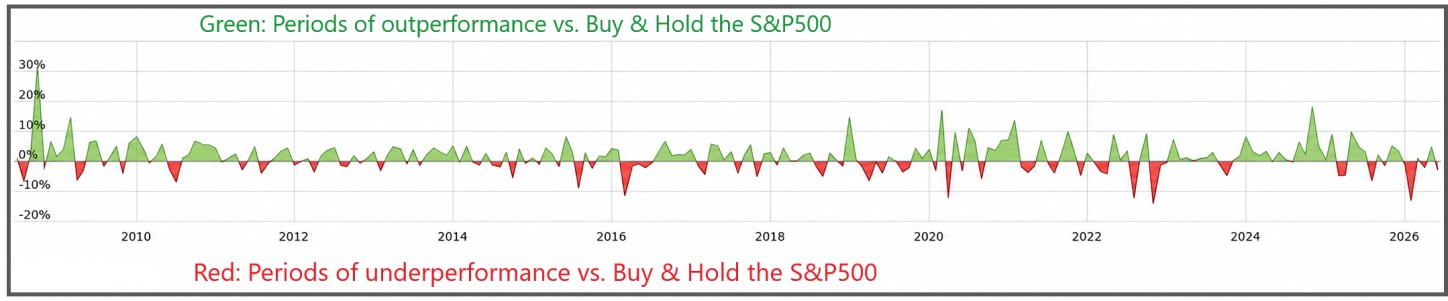
What matters is not merely the final result. What matters is the path taken to get there. And the road may feel uncomfortable.
You can observe several spells of underperformance. In hindsight, they look tolerable. In real time, they are painful. They test your patience because you do not know whether the strategy is merely going through a normal bad stretch or whether something has genuinely stopped working.
However, if we look back over two years, the picture changes completely, as shown in this chart:
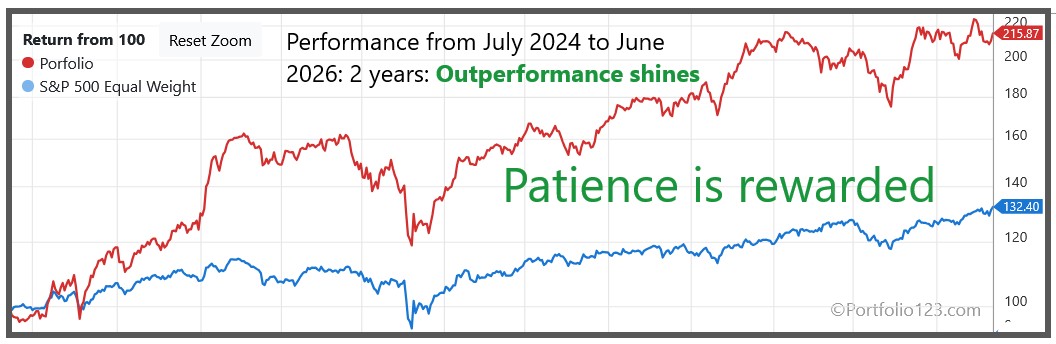
The same strategy becomes a strong outperformer. And if we extend the view to almost 20 years, its long-term outperformance relative to the S&P 500 becomes even clearer.
Importantly, these results are not based on a frictionless theoretical exercise. A substantial slippage assumption of 0.25% per side of each trade has been included. That matters because, especially when trading smaller and mid-sized companies, ignoring slippage can make a strategy look much better on paper than it would have been in the real world.
The key takeaway is simple: patience is essential. The more your portfolio differs from the S&P 500, especially if it includes smaller companies, the more likely you are to underperform the index for extended periods. Your edge may not show up every month, or even every quarter. Often, it appears in short, powerful bursts that more than offset the painful spells of relative weakness.
That is the price of outperformance, and it is a price that can only be paid by those with the patience and psychological fortitude to stay the course when the going gets tough. In the end, that is often what separates the winners from the losers.
Sincerely,
Manuel Blay
Editor of thedowtheory.com